Spectra and What They Hindquarters Tell Us

A rainbow rises over a misty forest. (Deferred payment: U.S. Fish and Wildlife Service)
A spectrum is simply a graph or a graph that shows the chroma of spark beingness emitted over a range of energies. Have you e'er seen a spectrum before? Probably. Nature makes beautiful ones we cry rainbows. Sunlight dispatched done raindrops is circulate out to display its various colours (the different colors are right the way our eyes perceive radiotherapy with slightly different energies).
Spectroscopy can be very useful in helping scientists understand how an object like a black hole, neutron star, or active galaxy produces light, how flying it is moving, and what elements it is composed of. Spectra potty be produced for any energy of light, from low-pitched-energy radio waves to very high-octane gamma rays.
Each spectrum holds a wide variety of information. For instance, in that respect are many different mechanisms by which an object, like a starring, can produce light. All of these mechanisms has a characteristic spectrum.
The Electromagnetic Spectrum
White light (what we cry visible or optical illuminating) pot be stock split into its constituent colors well and with a familiar result: the rainbow. All we have to do is use a slit to focus a narrow beam of the light at a prism. This setup is actually a basic spectrometer.

Spectrum of white light
The resultant rainbow is really a nonstop spectrum that shows the States the unusual energies of light (from bloody to blue) present in visible light. But the electromagnetic spectrum encompasses more just sense modality spark. It covers all energies of light, extending from low-energy radio waves, to microwaves, to infrared, to optical light, to ultraviolet, to very high-energy X-rays and da Gamma rays.
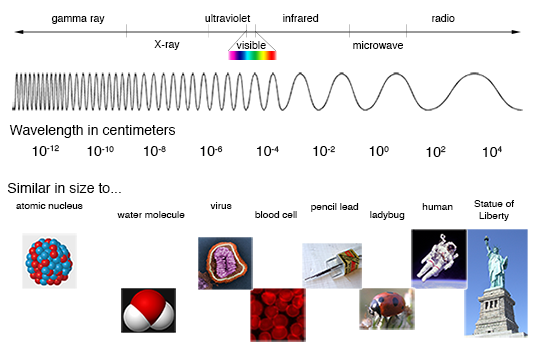
The full magnetic force spectrum. (Credit: NASA's Imagine the World)
 Tell Me More About the Electromagnetic Spectrum!
What Can Scientists Learn From a Spectrum?
Emission or Bright Line 
Absorption or Dark Line 
Three types of spectra: continuous, emanation line and absorption.(Credit: National Aeronautics and Space Administration's Imagine the Universe)
Each ingredient in the periodic table sack appear in gaseous form and will produce a series of bright lines unique to that factor. Hydrogen will not look like helium which will not look same carbon copy which wish non look like Fe... so on. Thus, astronomers hind end identify what kinds of stuff are in stars from the lines they find in the superstar's spectrum. This type of study is called spectrographic analysis.
The skill of spectroscopy is quite blase. From apparitional lines astronomers can set non only the element, but the temperature and density of that element in the star. The spectral line also can tell us about some magnetic field of the star. The width of the parentage can tell us how fast the material is moving. We can learn about winds in stars from this. If the lines shift back and forth we fundament learn that the star may be orbiting another star. We hind end estimate the mass and size of the leading from this. If the lines grow and fade in effectiveness we sack instruct about the physical changes in the sensation. Ghostly selective information can too tell us about material around stars. This material may be falling onto the star from a doughnut-molded disk around the star known as an accumulation disk. These disks often make some a neutron star or melanize hole. The light from the squeeze betwixt the stars allows astronomers to analyze the interstellar metier (ISM). This tells us what type of stuff fills the space between the stars. Space is not empty! In that location is oodles of throttle and dust between the stars. Spectrometry is uncomparable of the fundamental tools which scientists use to study the Universe.
Use Hera to analyze spectra.
Updated: August 2013
how do scientists use spectroscopy to learn about stars
Source: https://imagine.gsfc.nasa.gov/science/toolbox/spectra1.html
